
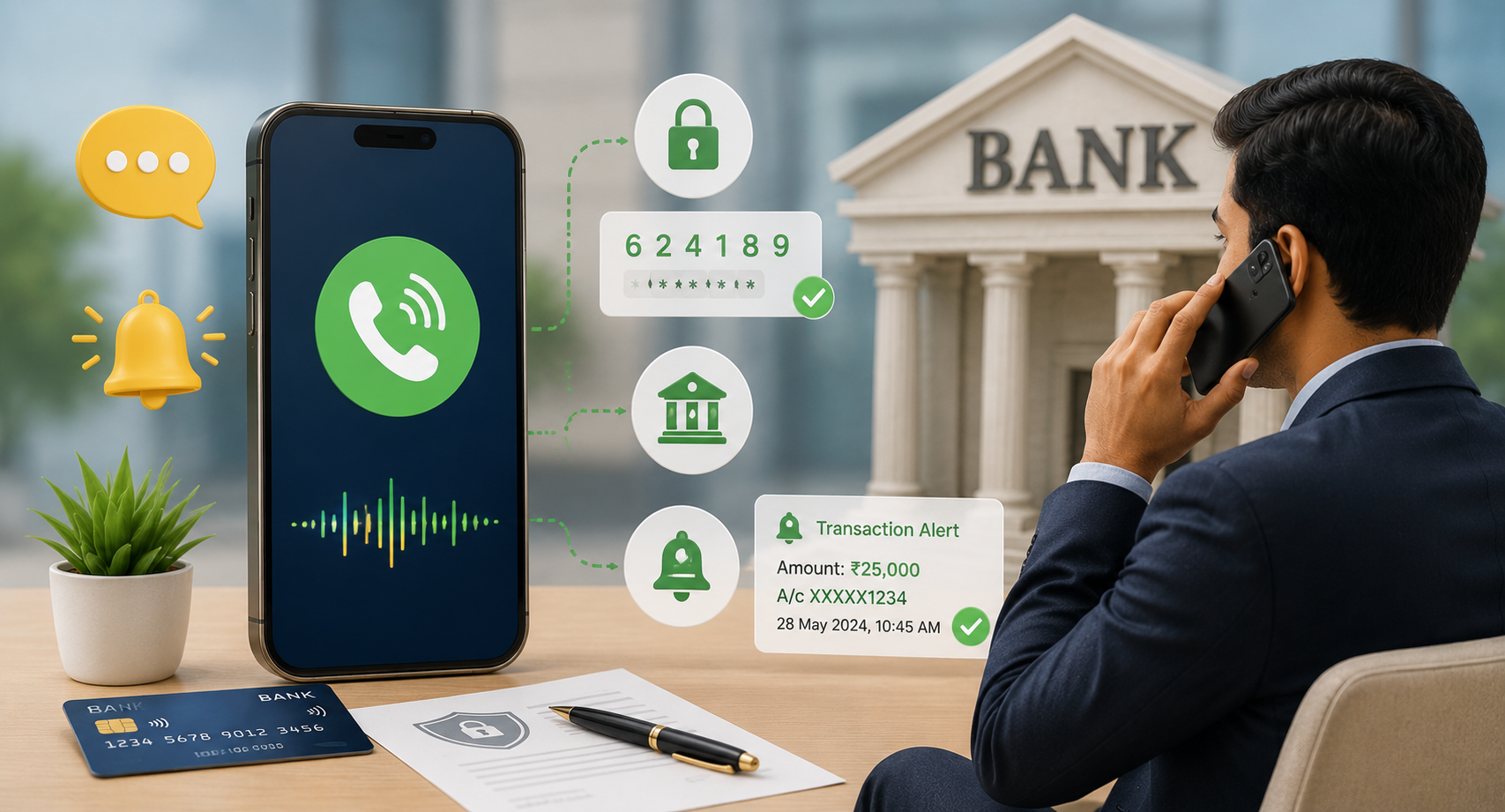
How to Send OTP and Transaction Alerts via Bulk Voice Call in Banking?
There is no room for delays in banking communication. Bulk Voice calls for banks in India offer the fastest and most reliable way to deliver OTPs, transaction alerts, and fraud warnings directly to customers. Every second counts because delay could cause friction, lower trust and expose a customer to fraud.
Bulk voice calls offer banks a quick and reliable way to send critical notifications and security codes over a clear, compliant medium. This helps banks reach out to customers quickly despite the delays that may be encountered with SMS messages. Bulk voice calling will also provide customers with additional assurance and trust regarding their account matters.
What Bulk Voice Call Means in Banking and Why Banks Use Voice
Bulk Voice Calling is an automated process in which voice calls are placed to numerous customers simultaneously, with a pre-recorded message played. In banking, it may be used to send one-time passwords, transactional confirmations, warnings about potential fraud, low account balance alerts, and loan reminders, among others. This is particularly useful where SMS fails to deliver.
Voice communication is preferred because it is more direct and more difficult to ignore than text communication. Voice communication is particularly useful for Indian banking customers who require immediate action, such as verification of a transaction or logging in to an account. Voice communication also has greater reach because it can be supported by different languages.
Where Voice OTP Fits for Banks
Voice OTP and Bank Alerts for banks in India work best in scenarios where speed, accuracy, and real-time customer focus are paramount.
- Voice OTP for logging into the internet and mobile banking can be used for rapid verification.
- Bank transaction alerts can be delivered using automated phone calls so that customers have immediate notification of all payments or transfers.
- Fraud alerts can warn customers about suspicious activity in real time and help them respond before damage is done.
- Account and balance alerts can notify customers about important changes without waiting for them to open an SMS.
- EMI reminders and loan servicing alerts can be sent as voice calls to keep repayment communication timely and clear.
If implemented during the appropriate times, voice-based one-time passwords (OTP) and transaction alerts allow banks to enhance their response times, build trust, and ensure that crucial communications don't go unnoticed.
Benefits of Bulk Voice Calls for Banks and Customers
The use of voice alerts helps banks ensure security, prevent any missed notifications, and enhance quick responses from customers. It also lessens pressure on support staff since most alerts can be automated rather than done manually. As for customers, voice messages are much more reliable when the subject is sensitive, time-sensitive, or financial.
This channel is also helpful for banks in building a stronger fraud-protection barrier. In other words, a client will give more importance to hearing an automated voice telling him/her about a questionable transaction than a simple message coming from his phone, which may get overlooked due to multiple other messages.
How Bulk Calls Work for a Banking Team
The entire procedure becomes fairly straightforward once the bank has integrated its systems with a voice delivery platform. Once there is a trigger, either through OTP or alert, the system places a call, and the message is delivered in voice format. The client can listen and follow the instructions as per the communication that is conveyed.
- Link the banking system or application to the voice API.
- Initiate the voice call based on a transaction or OTP trigger.
- Send the message via recorded audio or Text-to-Speech.
- Enable the recipient's response via keypad entry or next actions.
- Analyze delivery reports and call performance metrics.
Such an approach allows for rapid communication from the bank side while ensuring full traceability and security throughout.
Compliance and Security of Bulk Voice Calls
Voice communication in banking must adhere to the RBI regulations as well as those of the telecommunications sector. Transactions and service voice communications should be made through the 1600 series, while promotional communication needs to be limited to the 140 series only. The bank must also take care of the registration of templates and auditing.
But security does not solely depend on the call. It also depends on the authorized sender, proper routing, and the integration with core banking systems. With all these components in place, the voice notification becomes a reliable tool for the bank to use in its communication efforts.
Choosing the Right Provider for Bulk Calls Service
The banks in India must find a provider who can offer security, fast processing, compliance, and integration without complicating processes. Such a partner must be able to integrate with APIs for automation, multilingual voice messaging , auditing, and RBI workflows.
- Automation for OTP and alert trigger through API.
- Voice delivery that is safe for sensitive banking communications.
- Multiple languages that allow reaching out in the language the customer prefers.
- Delivery audit reports and logs.
- Workflow alignment with RBI requirements for transaction and service alerts.
- Simple integration with banking applications.
For banks in India looking for a reliable bulk voice call provider , Sequence Cloud Gateway makes it easy for banking professionals to deliver OTPs and transaction alerts safely using reliable bulk voice calls.
The Bottom Line
OTPs and transaction alerts are too vital to be dependent on insecure and delayed communications. Voice campaigns help banks rely on their ability to convey any urgent notifications and protect their customers' accounts. When it comes to modern banks, voice is no longer an optional channel for sending notifications; it is a must that should be leveraged for secure communications.
FAQs
Q.1 What is voice OTP in banking?
Voice OTP is a one-time password delivered through a phone call instead of a text message. It is used for login verification and other high-security actions.
Q.2 When should banks use voice alerts instead of SMS?
Banks should use voice when the message is urgent, security-sensitive, or likely to be missed in a crowded inbox.
Q.3 Are bulk voice calls secure for banking communication?
Yes, when they are routed through compliant systems with approved numbering, secure integration, and proper audit controls.
Q.4 Can voice OTPs work for transaction verification?
Yes, voice OTPs can support login checks and transaction confirmation workflows when banks need a reliable second-factor channel.
Q.5 How do banks get started with voice OTP alerts?
They should connect their banking systems to a compliant voice API provider, define OTP and alert templates, and configure delivery and audit tracking.